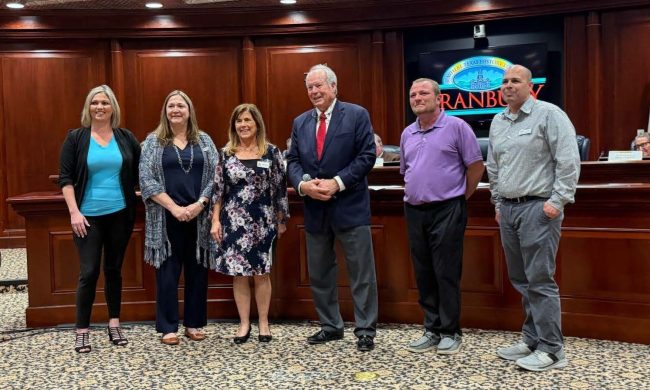
Mayor Jim Jarratt issued a proclamation March 3 during the Granbury City Council meeting recognizing April as Child Abuse Prevention Month. Also pictured, from left, are Rebecca Freeman, Jamie Franco, Margaret Cohenour, Justin Rossner and Kurt Turner.
Jeff Osborne | Hood County News
Posted Monday, March 9, 2026 7:41 am
Every day, usually hidden in the shadows and sometimes occurring in families you might never suspect, children are abused.
Protecting them from the threats they face and acknowledging this far too common but often under-recognized issue is a problem which must be addressed was a message proclaimed by the Granbury City Council, which issued a proclamation March 3 recognizing next month – April – as Child Abuse Prevention Month.
Abuse isn’t limited to April, of course. It is something that casts a dark shadow on lives 365 days a year.
One of the groups involved in the day-to-day efforts to protect, shelter and help children emerge from the trauma of child abuse is the Paluxy River Children’s Advocacy Center, based in Granbury.
The organization exists to serve as a lifeline to children who have been abused and to help ensure the justice system is responsive to children who have been harmed.
Margaret Cohenour, executive director of the Paluxy River Children’s Advocacy Center, which serves Hood, Somervell and Erath counties, said there are important things to recognize and do which can help prevent – or stop – child abuse.
“Prevention is key,” Cohenour said. “With a startling statistic that only one in 10 children will talk about their abuse, we developed a strong prevention program to reach the other nine who do not. We are going upstream to prevent abuse from occurring in the first place. We know preventive work yields enormous benefits not only to the child and family but the community as well. … We are providing prevention by training for professionals to improve their ability to identify and report child abuse; providing programs to educate parents and caregivers on recognizing signs of abuse, internet safety and how to create a safe environment for children; presenting to the community outreach and awareness campaigns to educate the broader community about child abuse prevention. We also provide personal safety education programs for school-age children focusing on recognizing abuse, resisting unsafe situations, and reporting to a safe adult.”
Asked what people can do when they discover a child is being abused, Cohenour said: “Be that safe adult. Remain calm. Make sure the child is safe. Do not ask for details or interview the child, but gather basic information and call the DFPS hotline to report: 800-252-5400 or txabusehotline.org. Also call local law enforcement, especially if the child is at imminent risk.”
What are some things that can be done to help children recover?
“Children are resilient. Their protective parent or caregiver needs to assure them they are safe and not at fault,” Cohenour said. “If they are referred for a forensic interview at the CAC, they will be greeted in a warm, child-friendly, safe environment where they will only have to tell their story one time, minimizing the trauma a child experiences repeating the story. The CAC was created to provide a safe space where children can share their stories, be heard, and begin their journey toward healing. Our family advocates help families throughout the course of the case – providing resources, making appropriate referrals. Some may need counseling services to overcome their traumatic event. We offer trauma-focused cognitive behavioral therapy for these children who have been sexually or physically abused, or witnesses to a significant traumatic event. We stay with the child through their journey to healing.”
The National Children’s Alliance states: “Child abuse is a horrific experience with potentially lasting effects. It’s also, unfortunately, a common experience in America and around the world.
While there are many types and levels of abuse, the U.S. Centers for Disease Control and Prevention reports: “One in four girls and one in 13 boys in the U.S. are estimated to experience sexual abuse.”
When considered internationally, the World Health Organization reports that at least a billion children experience sexual violence, including one in five European children.
The National Children’s Alliance further states: “U.S. child welfare authorities look into the safety of more than 7.5 million kids annually. Of those, 3 million received an investigation or alternate response from child protective service agencies.”
The impact is not only immediate harm to abused children, but it is also long-term, resulting in mental health issues, the likelihood of increased risky or harmful behavior and a negative impact on health even into adulthood, according to the CDC.
The tragic outcome and prevalence of abuse should not be underestimated. The alliance states: “Nearly half of all U.S. children experience at least one type of trauma. That exacts a toll on children, their caregivers, and their community, and our country as a whole also pays a price.”
TexProtects, the Texas Association for the Protection of Children, is a nonprofit organization based in Dallas and is dedicated to eliminating child abuse. The organization’s website states: “We believe every child has the right to a safe, nurturing childhood. That’s why TexProtects advocates for policy that protects children from abuse and empowers families to thrive.”
Statistics posted on the TexProtects website indicate that 146 children per day in Texas are confirmed to be victims of neglect or abuse; there were 53,543 confirmed victims of child abuse or neglect in 2024, and less than 2 percent of the families most likely to benefit from prevention programs currently receive services.
Abuse can affect children of any background, regardless of their family’s economic circumstances.
The Child Welfare League of America states that 546,159 children were confirmed as victims of abuse and neglect in 2023, which was actually a decrease from 558,899 victims the previous year. Unfortunately, there were an estimated 2,000 children who died because of child abuse and neglect in 2023, which was an increase from 1,990 deaths in 2022.
Locally, Cohenour said the Paluxy River CAC pulls data from the state database to monitor statistics. She said the most recent results indicate 578 reports of abuse in Hood County for 2025, with 337 for Erath County and 92 for Somervell County.
“We did 337 forensic interviews last year, provided prevention presentations to 10,405 people, trained 382 adults on recognizing and reporting abuse and outreach to 14,831 people,” Cohenour said.
She added that the majority of the time, the child who is victimized knows the abuser.
“Over 90 percent of the time, the perpetrator is someone the child knows and trusts,” Cohenour said. “The story many of us grew up with about ‘stranger danger’ is still real, but a much lower risk of that occurring. Parents need to be aware of what their children are looking at on social media. Online risks include inappropriate content, online privacy, online enticement, sexting, sextortion, cyberbullying. These are real problems in our community that we are providing education on wherever possible.”
While not traditionally thought of as a disease, it is a problem tracked by the Centers for Disease Control and Prevention. That organization states: “Child maltreatment is costly. In the United States, the total lifetime economic burden associated with child abuse and neglect was about $592 billion in 2018. This economic burden rivals the cost of other high-profile public health problems, such as heart disease and diabetes.”
Victims of abuse may suffer physical, emotional or psychological injuries, and later in life are prone to repeat the cycle of violence either as victims or perpetrators. Also, when they reach adulthood, victims of child abuse are more likely to engage in substance abuse and less likely to obtain higher levels of education or job advancement because of the lasting psychological trauma, according to the CDC.
“Everyone benefits when children have safe, stable, nurturing relationships and environments,” states the CDC. “We all have a role to play.”